

Quick answer. Compatibility matching compares two birth charts to show where a partnership flows naturally and where friction is structural. It covers emotional temperament, communication, values and the long-term outlook, and is used both before marriage and by couples already together who want to understand a recurring difficulty.
What a compatibility reading tells you
Compatibility is not a score out of ten, whatever the apps suggest. Two charts can show easy affection and difficult money, or constant low-level friction alongside a bond that outlasts everything. A proper reading describes the texture of a partnership rather than passing or failing it.
Master Vijay Ram looks first at the Moon in both charts, because emotional temperament governs daily life together more than almost anything else. From there he compares Venus and Mars for affection and desire, Mercury for how you argue and repair, and the seventh house in each chart for what each of you unconsciously expects a partner to be.
For couples considering marriage, this is combined with traditional guna milan and the dosha checks. For couples already together, the emphasis shifts: the useful question stops being whether to proceed and becomes which frictions are permanent features to be managed rather than problems to be solved.
The reading is delivered plainly, including the parts that are uncomfortable. Knowing in advance that money or in-laws will be your recurring pressure point is far more useful than discovering it in year three.

A clear, caring path
How the comparison is done
Both charts are cast, temperament and desire are compared, and the result is set out as clearly identified strengths alongside the friction that is structural rather than circumstantial. The reading is used both before a marriage is agreed and well into one.
Cast both charts
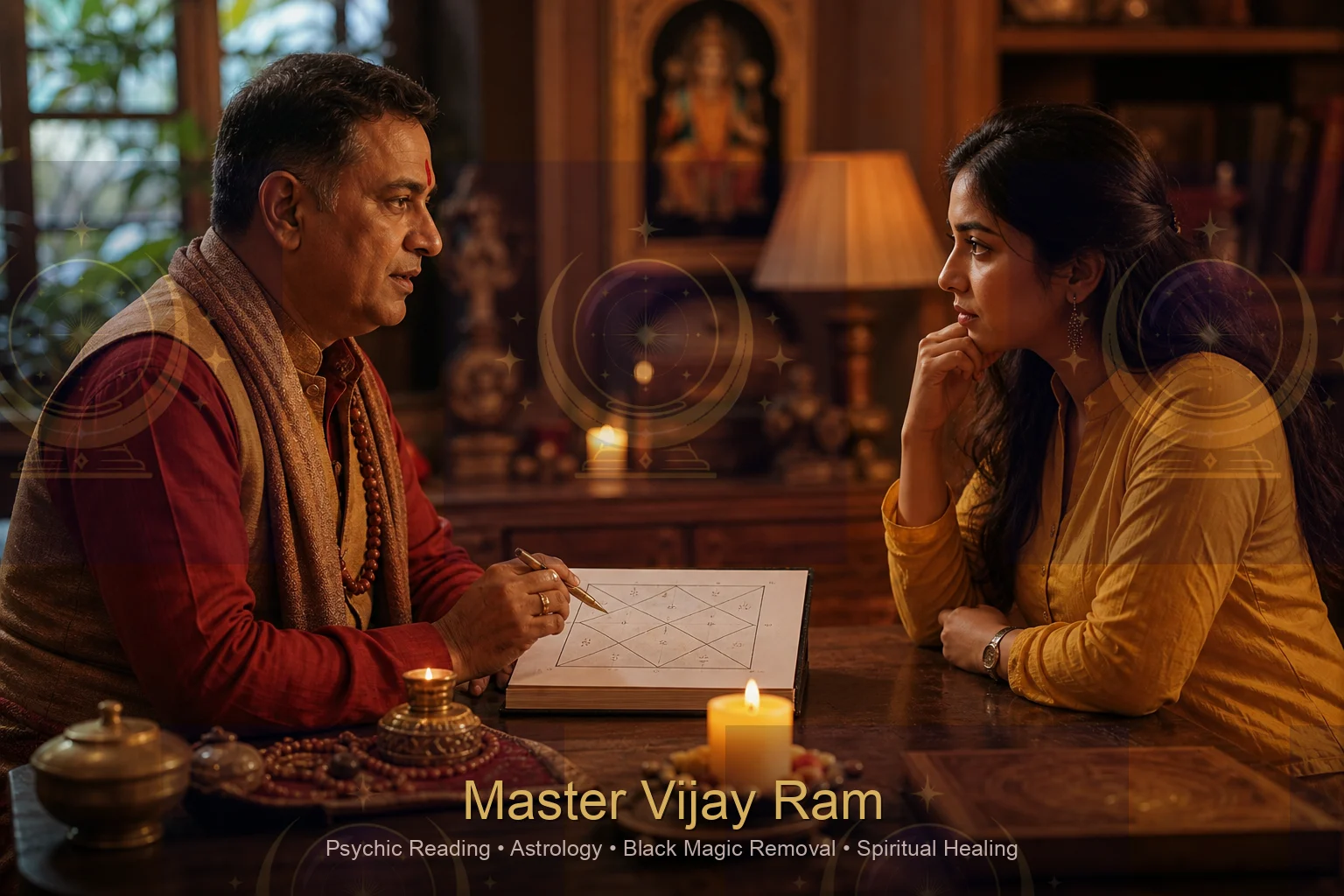
Birth date, time and place for both partners are cast into full kundlis. Accurate birth times matter here; where one is uncertain, rectification can be done first.
Compare temperament and desire
Moon signs, Venus and Mars placements and Mercury contacts are read across both charts to show how you handle emotion, affection, conflict and repair with each other specifically.
Set out strengths and friction
You receive a plain summary of what will come easily, what will need deliberate work, and what the long-term outlook is — with remedies where an affliction genuinely warrants one.
At a glance
Compatibility matching or guna milan?
Both are offered, and they answer different questions. Families arranging a marriage usually want the second; couples already together usually want the first.
| Compatibility matching | Guna milan | |
|---|---|---|
| What it compares | Temperament, communication, values and long-term outlook across both full charts | The traditional eight kootas, scored out of 36 |
| Produces | A description of where a partnership flows and where it strains | A numerical score plus the doshas found |
| Most used by | Couples already together, and those deciding privately | Families formally comparing a proposal |
| Birth time needed | Helpful; can proceed with an approximate time | Accurate time matters more |
Do any of these sound familiar?
When a compatibility reading helps most
Useful before a commitment, and just as useful well into one.
- You are considering marriage and want more than a guna score
- Families are matching charts and you want an independent reading
- The same disagreement keeps returning and you cannot see why
- One of you wants to commit sooner than the other
- You get on well but money or family causes constant strain
- A previous relationship failed the same way and you want to understand the pattern
Your questions, answered
Compatibility Matching — your questions answered
Guna milan is part of it, not the whole. The traditional 36-point system is a useful screen, but a full compatibility reading also compares Moon temperament, Venus and Mars, Mercury and both seventh houses — which is where the day-to-day texture of a marriage actually shows.
An approximate time still allows a great deal to be read, though house-based conclusions become less precise. Where the time is genuinely unknown, birth time rectification can narrow it using known life events before the comparison is made.
Yes, frequently. A difficult comparison points to where effort will be needed, not to a doomed marriage. What matters is whether both people know what they are taking on and are willing to manage it, which is precisely what the reading sets out.
Yes, and many couples come at that stage. The purpose shifts from deciding to understanding — knowing which friction is structural, and therefore worth managing rather than arguing about, changes how a couple handles it.
Completely. Nothing is shared with either family, and where only one partner books the reading, its contents remain theirs alone.