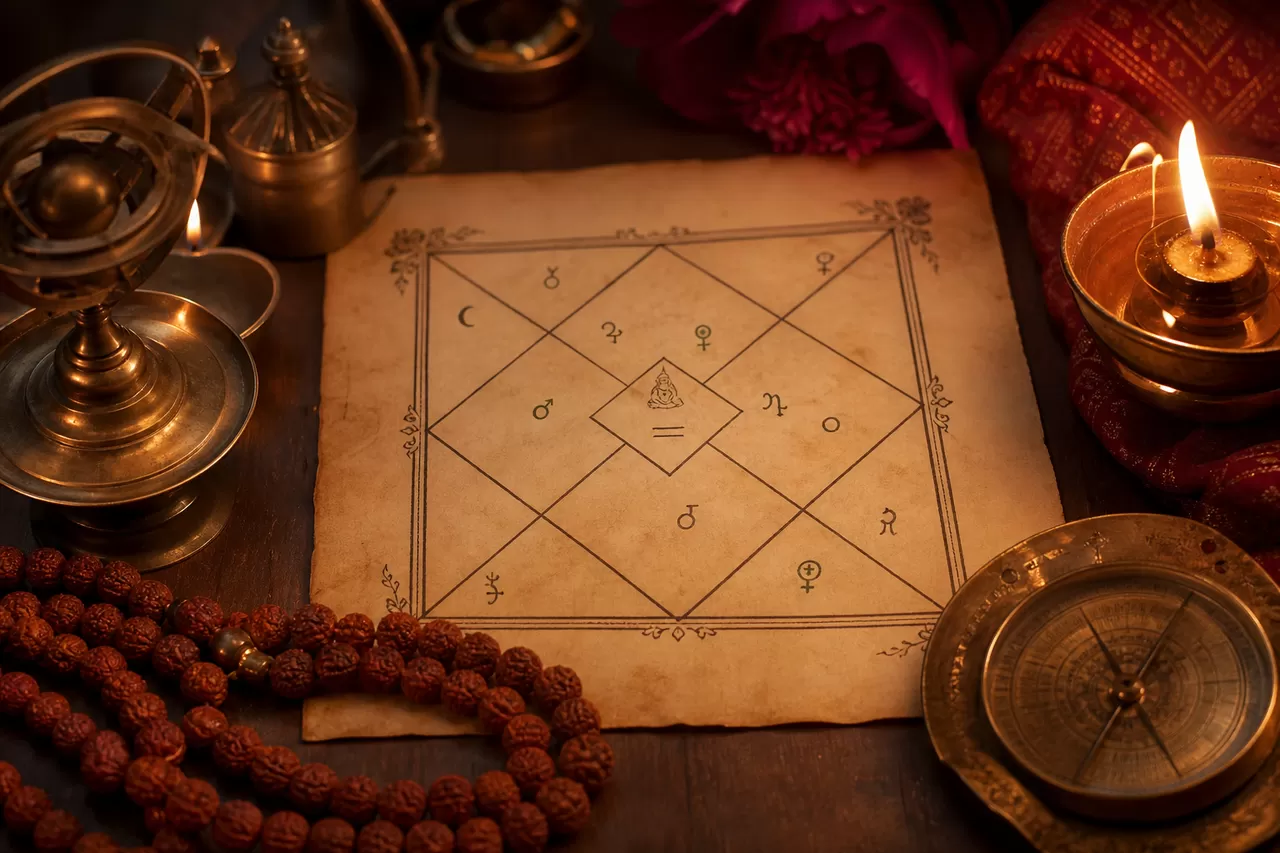

Sade Sati has a fearsome reputation, and a good deal of that reputation is manufactured by people selling remedies for it. The period is real, it is demanding, and it is also considerably better understood as three distinct phases with different characters than as one undifferentiated stretch of misfortune. Knowing which phase you are in changes what the period means.
How the period is defined
Saturn transiting the 12th, 1st and 2nd signs from your natal Moon — about two and a half years in each, seven and a half in total.
Saturn takes roughly thirty years to circle the zodiac, spending about two and a half years in each sign. Sade Sati begins when it enters the sign before your natal Moon and ends when it leaves the sign after — three signs, about seven and a half years.
Because it depends on your Moon rather than your Sun, it cannot be worked out from a birth date alone in the way newspaper astrology suggests. You need the Moon's position, which needs a reasonably accurate birth time.
It recurs every twenty-seven to thirty years, so most people meet it two or three times: often once in their twenties or thirties, once around retirement age. The phases can be dated precisely, which is the single most useful thing a consultation provides.
The three phases have different characters
First phase: expense and unsettlement. Second: the heaviest, affecting health and family. Third: finances and slow consolidation.
Treating the whole period as uniform is the main reason it is dreaded. The three phases behave differently.
First phase — Saturn in the twelfth from the Moon. Associated with expense, disrupted sleep, travel or relocation, and a sense of things draining away. Often the least dramatic and the most unsettling.
Second phase — Saturn over the natal Moon. Usually the heaviest. This is where emotional weight, health strain, family difficulty and low mood concentrate, and it is the stretch people describe afterwards in almost identical words regardless of circumstances.
Third phase — Saturn in the second from the Moon. Concerns finances, family responsibility and speech. Frequently carries a sense of slow consolidation: the difficulty is easing but the effort continues.
Why knowing your phase matters
Someone eighteen months into the second phase needs to hear that it lifts. Someone entering the third has largely passed the worst.
This is where a consultation earns its keep, and it has nothing to do with remedies.
Someone in the middle of the second phase is in the hardest stretch, and the most useful thing available is an accurate date for when it ends. Someone entering the third phase has largely passed the worst, whatever they have been told — and being told that the heaviest part is behind them changes how the remaining two years are carried.
Master Vijay Ram maps the phases against real dates so the period stops being an undifferentiated dread and becomes a known stretch with a known end. Clients frequently say that dating it was worth more than anything else in the session.

Saturn is demanding, not punitive
Saturn governs discipline, structure and earned result. Sade Sati is widely described afterwards as formative rather than merely difficult.
The fear attached to this period misrepresents what the tradition actually says about Saturn. It is classed as a natural malefic, but that describes its manner rather than its intent: Saturn is the planet of discipline, labour, justice, structure and result that is earned rather than given.
People describing these years afterwards very often identify them as formative — the stretch that built the discipline, ended the arrangement that was not working, or forced the change they had been avoiding. That is a different account from the calamity the remedy sellers describe.
It is also why the traditional remedies are what they are. Saturn responds, in this tradition, to service and consistency rather than expenditure: a mantra held daily, Saturday observance, oil offerings, charity directed to labourers and the elderly, and practical service to people who need it.

What genuinely helps, and what does not
Nothing shortens a transit. Remedies ease how it is experienced. Anyone offering to end it early is being dishonest.
Start with what is not true: nothing shortens a planetary transit. Saturn will spend the time it spends in each sign. Any offer to end Sade Sati early, for a fee, is dishonest, and this period attracts more of that than almost any other.
What traditional remedies are understood to do is ease how the period is experienced and direct its demands more constructively. The Shani mantra held consistently. Saturday observance and fasting. Sesame oil offerings. Charity to the elderly, to labourers, to those doing hard and unnoticed work. Where a chart warrants it, a Shani puja or grah shanti.
The unglamorous nature of that list is the point. The tradition is quite consistent that Saturn is met with steadiness rather than expenditure, and a modest practice held for three years is worth more than an elaborate ceremony bought in a panic.



Serving nearby: Waterloo · Cambridge · Guelph · Brantford
Key takeaways
- Sade Sati is Saturn transiting the signs before, on and after your natal Moon — about 7.5 years
- It divides into three phases with distinct characters; the middle one is heaviest
- Dating the phases precisely is usually more useful than any remedy
- Saturn is demanding rather than punitive — many describe the period afterwards as formative
- Nothing shortens a transit; anyone offering to end it early for a fee is not honest
In closing
If the last few years have felt uniformly heavy without an obvious cause, having your Moon located and the phases dated is a straightforward hour of work. Knowing which phase you are in, and precisely when it ends, does more for most people than any remedy prescribed on top of it.