
Few labels in Vedic astrology cause as much distress as this one. A report comes back saying Manglik, a family withdraws from a match, and an engagement ends — often without anyone establishing whether the dosha is actually present after the classical cancellations are applied. Given how many charts the basic rule catches, that is a lot of decisions made on an incomplete reading.
The rule catches an enormous number of charts
Six of twelve houses trigger the basic rule, so a very large proportion of people qualify on a first pass.
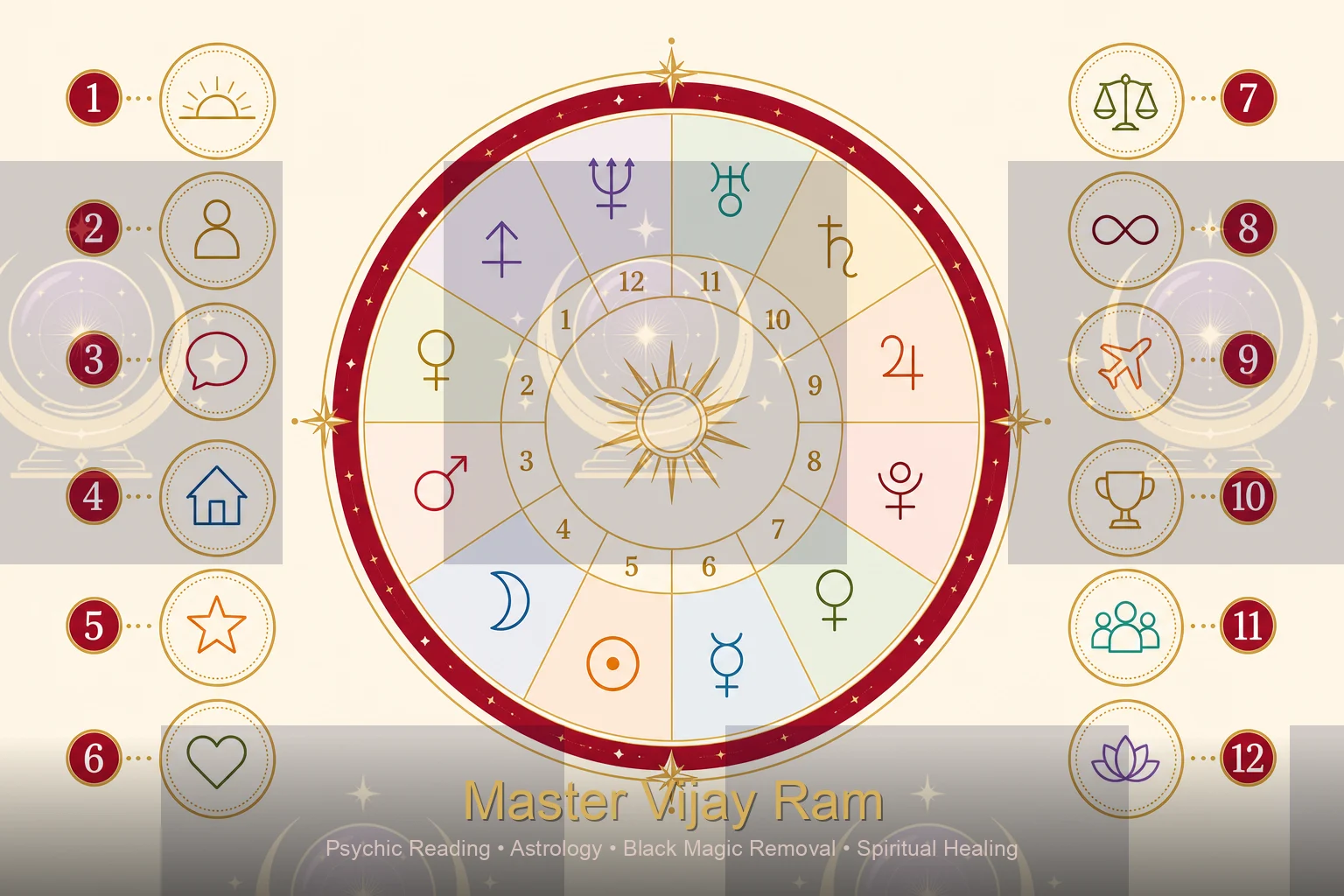
Start with the arithmetic, because it explains most of the problem. Mars occupying the first, second, fourth, seventh, eighth or twelfth house from the ascendant is said to create the dosha. That is six houses out of twelve.
Mars is in some house in every chart. If the placements were evenly distributed you would expect roughly half of all people to qualify on the basic rule alone, and in practice estimates commonly put it around a third once the reference points are applied properly.
A label attaching to a third of the population is not describing an unusual affliction. It is describing a common placement — which is precisely why the classical literature surrounds it with conditions rather than leaving it as a flat rule.
It must be assessed from more than one point
Properly, Mangal dosh is checked from the ascendant, the Moon and Venus. A single-reference reading is where many errors begin.
The rule is usually quoted from the ascendant. Classical practice assesses it from three reference points: the ascendant, the Moon and Venus.
This cuts both ways. A chart clear from the ascendant may show the placement from the Moon, which a quick reading misses. Equally, a chart flagged from one point may be unremarkable from the others, which changes how much weight the finding deserves.
A great many of the reports that arrive here were produced from a single reference and presented as a verdict. That is not a small technical quibble — it is the difference between a finding worth attending to and a finding that should never have been stated so firmly.
The cancellations most reports never apply
Mars in its own sign or exalted, Jupiter's aspect, mutual dosh between partners, age and particular sign placements can all nullify it.
Here is where the label most often falls apart on careful reading. Classical texts set out numerous conditions under which Mangal dosh does not apply, including:
Mars in its own sign or exalted — in Aries, Scorpio or Capricorn, the placement is strong rather than afflicting. An aspect from Jupiter on Mars or on the house concerned. Mutual dosh, where both partners carry the placement, which traditional practice generally treats as neutralising. Age, with the effect widely held to diminish after the late twenties. Particular sign placements where Mars sits comfortably.
These are not obscure exceptions invented to reassure people. They are in the classical literature, and skipping them is what turns a common placement into a family crisis.

What the placement actually indicates
Mars brings heat, drive and directness. In marriage that means friction to manage, not a doomed relationship.
Set the label aside and consider what Mars actually signifies: energy, drive, courage, competitiveness, directness, impatience. Placed in the houses concerned with the self, the home and partnership, it colours those areas with that temperament.
Traditionally this is read as friction — arguments that flare, impatience with a slower partner, a tendency to force matters that would settle on their own. It is a description of temperament to be managed, and countless people with the placement have long, settled marriages.
What it is not is a prediction of catastrophe. The more alarming folklore attached to the label — that a Manglik will cause a spouse's death — is not something a careful practitioner will assert, and it has caused an enormous amount of avoidable fear.

Remedies, and the one most often oversold
Where a genuine uncancelled dosh remains, traditional remedies exist. Kumbh Vivah is recommended far more often than it is warranted.
Where the dosha genuinely stands after every cancellation has been considered, traditional remedies are available and are straightforward: the Mangal mantra, fasting on Tuesdays, charity associated with Mars, and in some cases a specific puja.
Kumbh Vivah — the symbolic marriage to a pot or tree performed before the real wedding — is the remedy most often recommended and most often unnecessary. It remains a legitimate traditional option for a strong, uncancelled dosha. It is also frequently proposed to people whose dosha cancels on a careful reading, and it tends to come with a substantial fee.
If it has been suggested to you, that is a good moment to have the chart assessed independently. A second opinion costs a fraction of the ceremony, and reasonably often establishes that nothing requiring it was ever present.

Serving nearby: Waterloo · Cambridge · Guelph · Brantford
Key takeaways
- Six of twelve houses trigger the basic rule, so a very large share of charts qualify
- Proper assessment checks Mars from the ascendant, the Moon and Venus — not one point
- Classical cancellations include own sign, exaltation, Jupiter's aspect, mutual dosh and age
- The placement indicates friction to manage, not a doomed marriage
- Kumbh Vivah is recommended far more often than a careful reading warrants
In closing
If you have been told you are Manglik, the useful next step is not a remedy but a proper assessment. Establish whether the placement holds from all three reference points and whether any cancellation applies. A great many people carrying this label, on a careful reading, have nothing that needs doing at all.